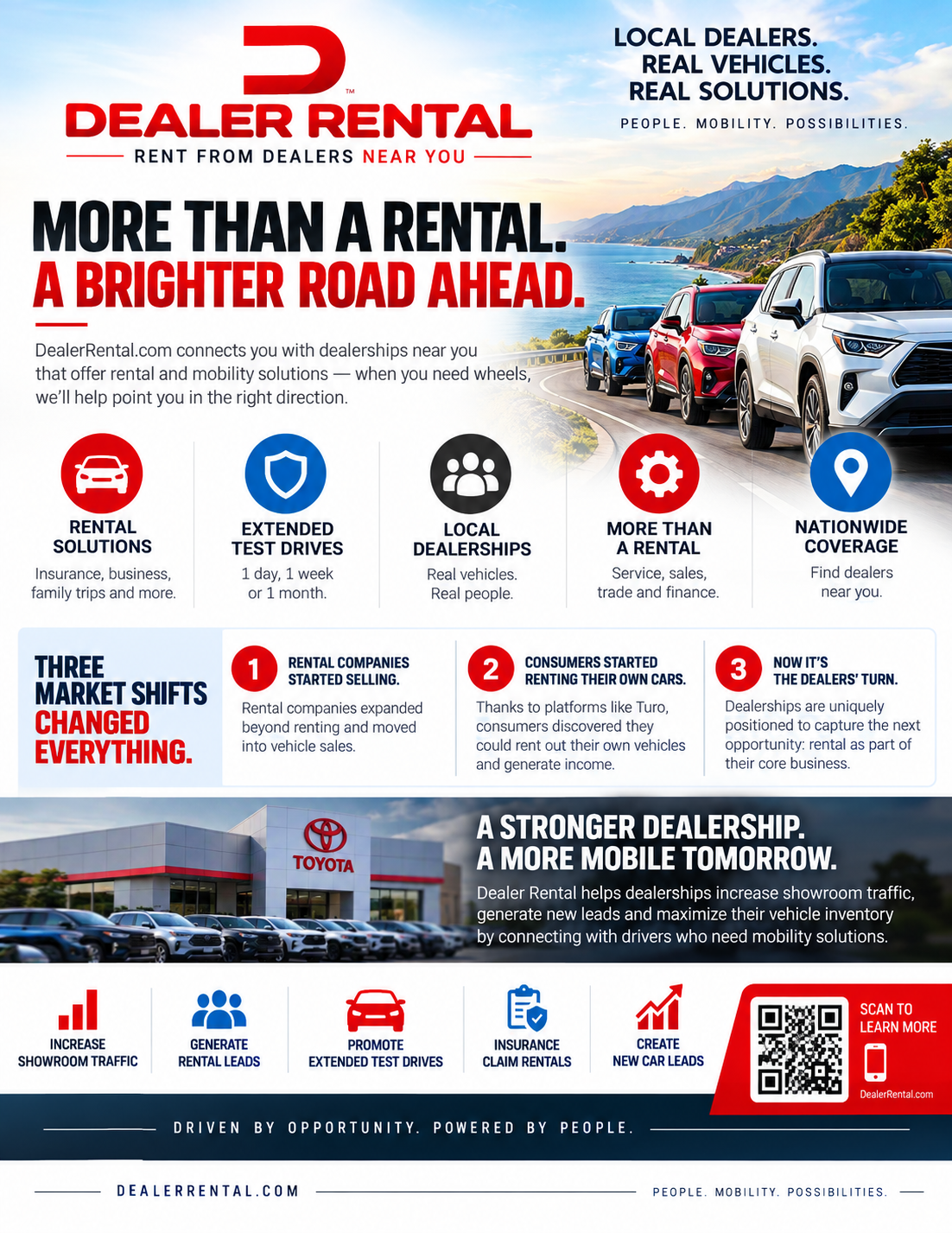
Dealer Rental
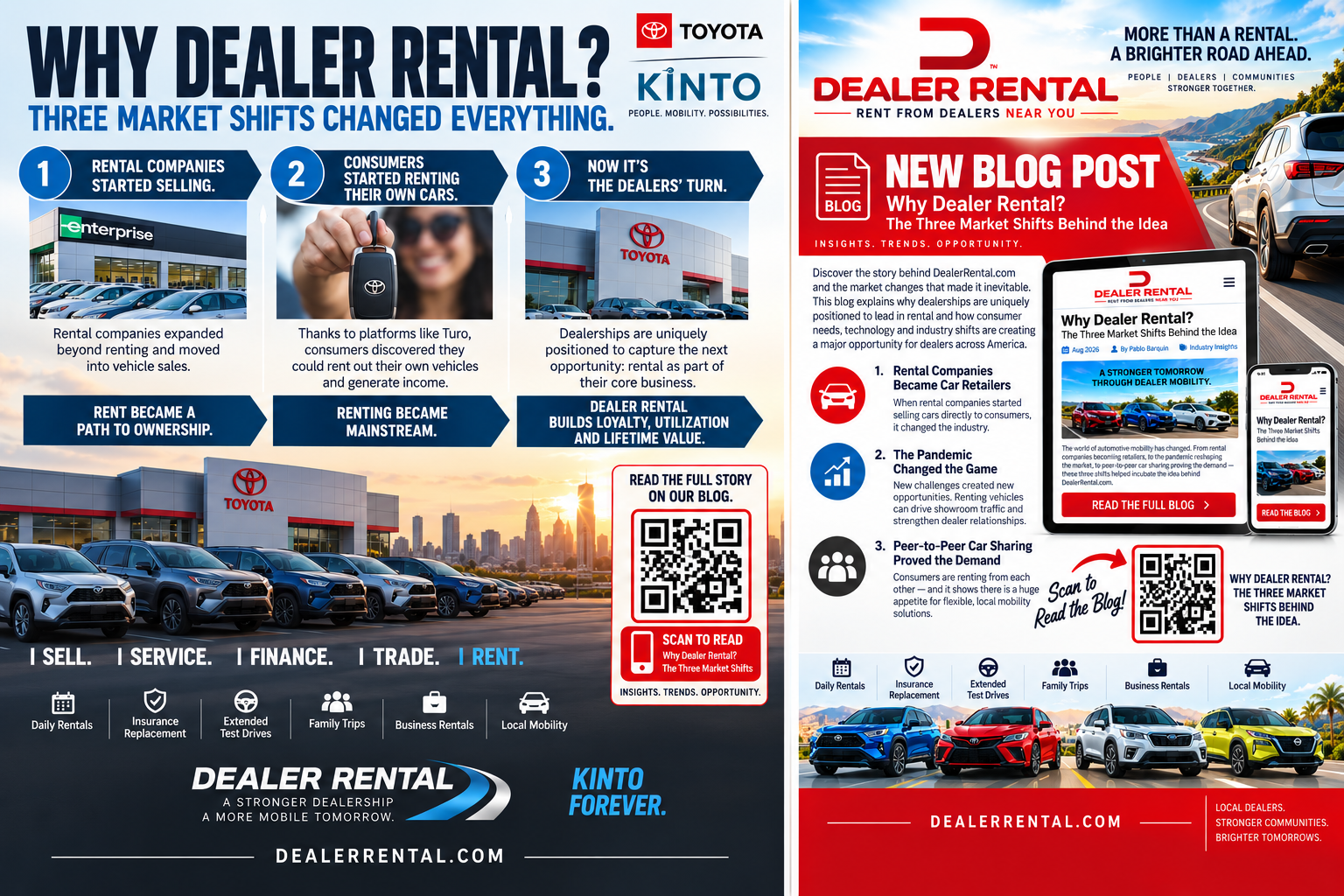
Why Dealer Rental? The Three Market Shifts Behind the Idea
Information is provided for general reference only. Availability, rental terms, and participating dealership details may vary by location.
Industry Perspective
Why Dealer Rental? The Three Market Shifts Behind the Idea
Rental companies became car retailers. A pandemic changed the economics of the showroom. Peer-to-peer platforms proved people will rent from almost anyone. Here's how three major market shifts led to the creation of DealerRental.com.
Dealer Rental wasn't an idea that came to me overnight.
It developed over years of watching the automotive industry change—sometimes dramatically—and asking a relatively simple question:
If everybody else is finding new ways to monetize vehicles, why shouldn't car dealerships?
After more than 20 years working in digital automotive, including experience with Autotrader.com and Cars.com and working with OEMs, dealer groups, franchise and independent dealerships, I've watched the traditional automotive ecosystem evolve from many different angles.
Three major changes in particular helped incubate the idea behind DealerRental.com.
Driver #1: Rental Car Companies Became Car Retailers
This was probably the first big lightbulb.
Historically, rental car companies were an important part of the automotive wholesale ecosystem. OEMs sold large volumes of vehicles into rental fleets. Rental companies operated those vehicles for a period of time and eventually removed them from service. Those vehicles frequently flowed back into the traditional automotive ecosystem through auctions, wholesalers and dealerships. The dealership ultimately played an important role in bringing many of those vehicles back to the retail consumer.
Then something significant happened.
Rental car companies began selling vehicles directly to consumers.
Instead of simply disposing of fleet vehicles through traditional wholesale channels, rental companies realized they could become retailers themselves. They could rent the vehicle. Then sell the vehicle. And potentially capture more of the economics along the way.
Large rental companies developed retail locations, consumer-facing websites and sophisticated online used-car marketplaces.
From my perspective, this was a significant shift for automotive retailers. Rental companies had entered the dealership's business. They were no longer simply supplying vehicles into the used-car ecosystem. They had become competitors for the retail automotive customer.
The traditional path could look something like:
OEM → Rental Fleet → Auction/Wholesale → Dealer → Consumer
Increasingly, another path became possible:
OEM → Rental Fleet → Consumer
That removes steps from the traditional ecosystem and allows the rental company to participate directly in retail automotive margins.
I remember thinking: If rental companies can become car dealers, why can't car dealers become rental companies?
That question stayed with me. Perhaps the competitive response wasn't to complain about rental companies entering automotive retail. Perhaps dealerships should simply move in the other direction. They should rent.
Driver #2: The Pandemic Changed the Economics of the Showroom
Then came the pandemic.
The automotive industry experienced a combination of conditions few of us had ever witnessed simultaneously. Showroom traffic changed dramatically. Vehicle production was disrupted. Semiconductor shortages constrained new-car inventory. Supply chains became unpredictable. Used-car prices increased dramatically. Employment conditions changed. Consumer confidence fluctuated.
Dealers had to rethink how they generated revenue, managed inventory and maintained relationships with customers.
During that period, I kept coming back to another simple thought: What if dealerships could generate traffic by renting vehicles?
A rental customer has a reason to visit the dealership. They walk onto the property. They interact with dealership personnel. They experience the dealership. They may drive a vehicle they have never driven before. And today's rental customer could eventually become tomorrow's service customer, used-car customer, new-car buyer, finance customer or trade-in opportunity.
Instead of thinking about the dealership strictly as a place where someone goes when they are ready to buy a car, I began thinking about the dealership as a local mobility center.
- Need a vehicle for three days? Come to the dealership.
- Need transportation while your car is being repaired? Come to the dealership.
- Want to spend a week with a vehicle before deciding whether to buy it? Come to the dealership.
- Need an SUV for a family trip? Come to the dealership.
- Need a vehicle for business? Come to the dealership.
Rental could create another reason for consumers to enter the dealership ecosystem. And traffic has always mattered in automotive retail.
Driver #3: Peer-to-Peer Car Sharing Proved That People Will Rent From Almost Anyone
Then another major change occurred.
Peer-to-peer car sharing became mainstream. The Airbnb concept came to automobiles. People began renting vehicles from other people. Your neighbor could own an extra vehicle, put it onto a platform and generate income from an asset sitting in the driveway.
Consumers demonstrated something important: People don't necessarily care whether their rental vehicle comes from a traditional airport rental counter. They need wheels.
Across America, individuals began monetizing their personal vehicles. Cars became income-producing assets. And I kept looking at the automotive landscape thinking: Everybody is renting cars—except most car dealerships.
That seemed backwards.
Think about what a dealership already has: vehicles, parking, service facilities, detail departments, trained employees, finance departments, insurance experience, technology, customer databases, marketing infrastructure, physical locations, brand recognition, OEM relationships—and perhaps most importantly, thousands of people living and working around the dealership who occasionally need transportation.
Dealerships already possess many of the ingredients necessary to participate in mobility. Some already do. Toyota dealerships have operated rental programs. Nissan dealerships rent vehicles. Subaru dealerships participate in rental programs. Honda dealerships and dealers representing other manufacturers have offered rental and loaner programs in various forms.
That tells us something important. Dealer rental isn't theoretical. It already exists. The bigger opportunity is expanding the concept.
Leveling the Automotive Playing Field
Put these three trends together and an interesting picture emerges.
Rental companies moved into automotive retail. Peer-to-peer platforms enabled ordinary vehicle owners to enter the rental business. Consumers became comfortable obtaining transportation from entirely new sources. Meanwhile, thousands of dealerships remained focused primarily on selling and servicing vehicles.
I believe dealerships have an opportunity to expand that definition.
If rental companies can sell cars, and consumers can rent their cars to strangers, why shouldn't dealerships rent vehicles to their communities?
In some ways, dealer rental helps rebalance a marketplace that became unbalanced when traditional rental companies moved aggressively into automotive retail.
Rental companies effectively said: "We rent cars—and now we're going to sell them too."
Dealerships can respond: "We sell cars—and now we're going to rent them too."
That isn't abandoning the dealership business model. It's expanding it.
The 360-Degree Mobility Dealership
This ultimately leads to what I believe the modern dealership can become. A true community mobility center.
The dealership relationship doesn't have to begin when somebody decides to purchase a vehicle and end when they drive away. It can exist throughout the entire automotive ownership and mobility cycle.
I am the dealer. I sell. I service. I finance. I rent. I take trades. I buy vehicles. And I sell again.
Everything automotive. Everything mobility. Right here in the community.
That's 360-degree mobility.
A consumer may rent from the dealership today, service a vehicle there next month, take an extended test drive next year and eventually purchase their next vehicle from that same dealership. Rental isn't necessarily a separate business from automotive retail. Rental can become another door into automotive retail.
Why DealerRental.com Exists
That's ultimately why I created DealerRental.com.
The idea is to help consumers discover dealerships that provide rental and mobility solutions while encouraging more franchise and independent dealerships to consider the opportunity. Insurance replacement rentals. Business rentals. Family trips. Service-related transportation. Paid extended test drives. Traditional daily rentals. Local mobility.
Different customers have different reasons for needing a vehicle. But they all have one thing in common: They need wheels.
And there is often a dealership nearby with vehicles, people, infrastructure and the ability to serve them.
The world of automotive mobility has changed dramatically. Rental companies became retailers. Consumers became rental-car operators. Technology changed how people find, reserve and purchase vehicles.
Now I believe it's the dealership's turn.
The next evolution of automotive retail may not simply be selling more cars. It may be getting more value from the vehicles, facilities, people and relationships dealerships already have.
Sell. Service. Finance. Trade. Rent. Repeat.
That's the Dealer Rental idea. And I believe we're only getting started.
Topics
Written by
Pablo Barquin